

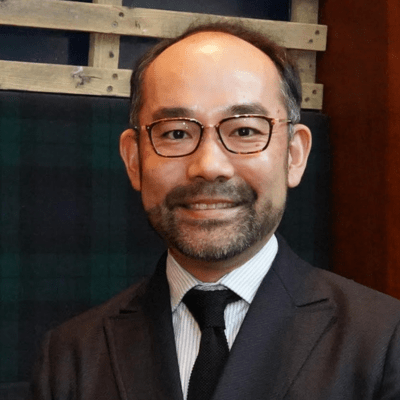
This blog, written by Ted Takahashi, Vice President of Global Technology and Innovation at Universal Studios Japan, highlights the perspective of an IT executive experienced in driving technology strategy and operational excellence. Ted participated in the Cambridge Advanced Leadership Programme in 2019 and later studied for the Cambridge Executive MBA from 2021 to 2023.
What challenges in your leadership journey prompted you to pursue the Cambridge Advanced Leadership Programme?
Before attending the Cambridge Advanced Leadership Programme, my primary challenge was a growing sense of limitation in how I was approaching leadership in an increasingly complex environment.
Through several years of management experience in the United States, I had become effective at solving operational and tactical problems. However, as my role expanded to include multi-country teams across the US, Japan, and Europe, the nature of the challenges I faced began to change fundamentally. Many of the issues were no longer technical problems with clear solutions, but rather deeply human and contextual challenges involving culture, values, ambiguity, and competing stakeholder expectations.
I became increasingly aware that my thinking relied heavily on experience-driven, high-context, and linear problem-solving approaches. While effective in familiar environments, these approaches showed clear limitations when dealing with organisational change, cross-cultural leadership, and situations where no single “right answer” existed. I felt a strong need to intentionally acquire new frameworks and perspectives to avoid leadership stagnation and to remain effective at scale.
The Cambridge ALP stood out as a programme that did not simply offer leadership tools, but instead challenged participants to fundamentally re-examine how they think, decide, and lead under uncertainty. I saw it as a necessary step to recalibrate my leadership approach for the next stage of my career.
How did the Cambridge Advanced Leadership Programme influence your leadership approach?
The most profound impact of ALP was not a single concept or skill, but a transformation in how I view leadership itself.
The programme brought together perspectives from business, technology, politics, psychology, ethics, and global economics, deliberately forcing participants to examine their own assumptions. Engaging with senior leaders from diverse industries and regions gave me a powerful external lens through which I could better understand my own biases, defaults, and blind spots.
One of the most significant shifts was moving away from a “leader-as-problem-solver” mindset toward seeing leadership as the ability to design conditions in which others can adapt, think, and act effectively. ALP helped me recognise how strongly I had relied on “how things should be” thinking, and how such rigidity, while well-intentioned, can unintentionally suppress team performance and learning.
The personal coaching and peer feedback components were particularly impactful. Receiving candid, high-quality feedback from individuals with whom I had no prior working relationship, but with whom I had built trust over the programme, allowed for a level of self-reflection that would have been difficult to achieve in my normal professional environment.
How did the Cambridge Advanced Leadership Programme influence your leadership approach?
Following ALP, there was a noticeable shift in my leadership behaviour almost immediately. My communication became more deliberate and inclusive, with greater emphasis on context-setting and shared understanding rather than implicit assumptions. I also began to place far greater emphasis on delegation and empowerment, focusing less on being the person with the best answer and more on removing obstacles so that my team could operate autonomously.
This shift proved especially valuable during the COVID-19 crisis. Under conditions of heightened uncertainty and speed, my teams began to operate more independently and in parallel, identifying issues and executing solutions with minimal central direction. Concepts discussed in ALP, particularly around adaptive leadership, moved from theory into lived experience.
Beyond my own role, I have actively worked to share what I learned through ALP with my organisation. This has included adopting more coaching-oriented conversations with my leadership team, rethinking how we approach decision-making under ambiguity, and inviting my Cambridge executive coach to conduct sessions with my managers. These efforts helped establish a more reflective and resilient leadership culture within the team.
How has the Cambridge Advanced Leadership Programme influenced your long-term career journey and commitment to continuous learning?
ALP fundamentally reshaped my relationship with learning.
The programme acted as a clear trigger for pursuing further, structured executive education, leading me to enrol in the Cambridge Executive MBA. Through ALP, I experienced firsthand the distinctive value of the Cambridge learning environment, its intellectual rigour, interdisciplinary perspective, and emphasis on reflective leadership. This experience made it evident that continued engagement with Cambridge would be the most effective way to deepen and sustain my leadership development.
The Executive MBA has allowed me to build on the foundations established during ALP, applying more advanced academic frameworks to real organisational challenges while continuing to refine my leadership practice. Together, ALP and the Executive MBA have formed a coherent and progressive learning journey rather than isolated educational experiences.
What began as a short executive programme evolved into what I would describe not as a life‑changing experience, but a life‑amplifying one, deepening the trajectory I was already on while expanding its scope and ambition.
Closing Reflection
The Cambridge Advanced Leadership Programme was not about replacing my prior experience, but about reframing it. It equipped me with a richer vocabulary, broader perspective, and deeper self-awareness to lead in complexity—and it became the catalyst for continued learning through the Cambridge Executive MBA. I am confident that the lessons from ALP and the wider Cambridge ecosystem will continue to inform my leadership for many years to come.